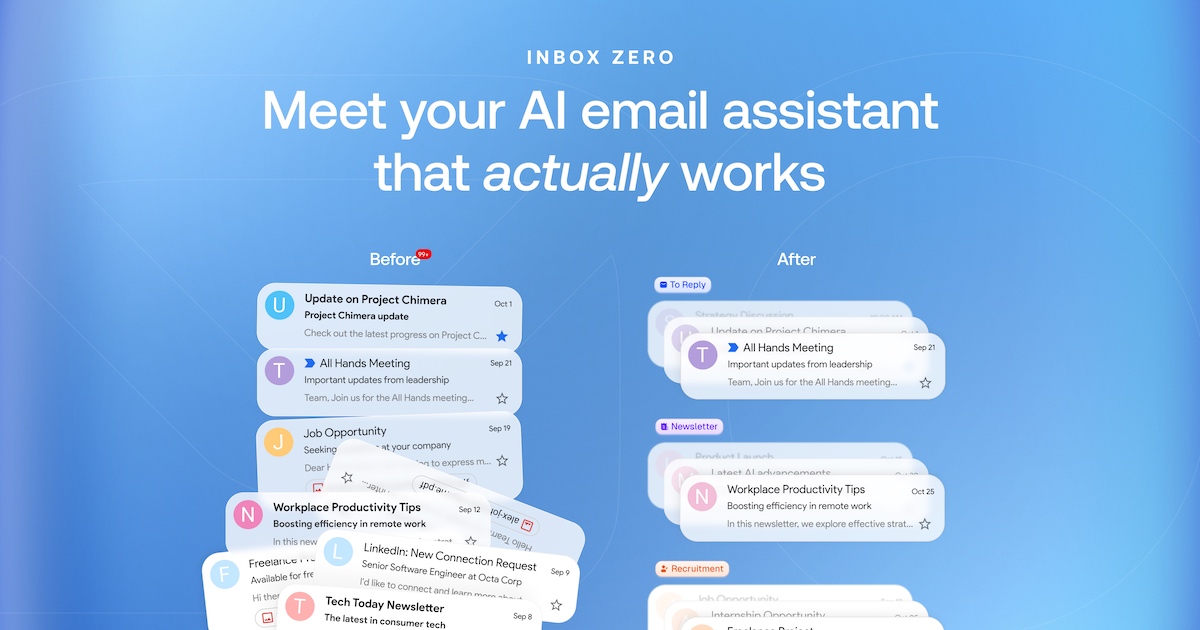
Inbox Zero – AI Tool for Email
Reach inbox zero in minutes.
Reviews & Comments
Become the first to write about this tool
TL;DR — Inbox Zero
Reach inbox zero in minutes. Security: Published posture.
What is Inbox Zero?
Inbox Zero is a highly efficient tool designed to help users achieve a clutter-free inbox. As a virtual assistant for emails, it provides various features to streamline email management and maximize productivity. With email analytics, users can gain insights into what fills up their inbox, allowing them to better understand their email patterns and take appropriate actions. Through one-click unsubscribe, users can easily clean up newsletter and marketing subscriptions, reducing clutter and saving time. The tool also offers the capability to automatically handle emails based on predefined instructions, enabling users to automate replies, archiving, and labeling. This feature can be customized using plain English instructions, making it easy to communicate preferences to the AI assistant. Additionally, Inbox Zero provides in-depth inbox analytics to help users understand their inbox better, including identifying frequent senders and types of emails received. By automating repetitive tasks, such as auto replying, forwarding, and archiving, the tool reduces manual effort, allowing users to focus on more important matters. Notably, Inbox Zero prioritizes data privacy, assuring users that no emails are stored in their database. Open-source code is available, ensuring transparency and enabling users to self-host their instance of the tool for enhanced data privacy. By leveraging AI technology, Inbox Zero empowers users to effectively manage their email inbox and boost productivity.
Security Assessment
Published posture scored 12/20 or above. We check HTTPS, a reachable privacy policy, and stated compliance commitments. We do not perform security testing.
Last assessed: 21 August 2026
How this score was built
Each scored criterion links to the published page it was derived from. Unscored criteria are marked, not guessed. This listing has not been hands-on tested.
- 8/10
Security & Data Privacy
The privacy policy outlines data controller and processor roles under GDPR, indicating strong data privacy practices.
Source: getinboxzero.com - 8/10
Functionality & Features
The homepage describes various features of the product, including email organization and drafting replies.
Source: getinboxzero.com - Not assessed
Ease of Use
Requires hands-on use of the product.
- 8/10
Pricing & Value
The pricing page details multiple plans, including a free trial and affordable paid options.
Source: getinboxzero.com - Not assessed
Reliability & Performance
Requires hands-on use of the product.
- Not assessed
Integration Capabilities
No citable published evidence in this pass.
- 8/10
Customer Support
The support page provides contact information and indicates availability for assistance.
Source: getinboxzero.com - Not assessed
Company Stability
No citable published evidence in this pass.
- 5/10
Update Frequency
The changelog shows updates but lacks detailed frequency or recent dates.
Source: inboxzero.featurebase.app - 8/10
Startup-Friendliness
The pricing page mentions a free trial, indicating support for startups.
Source: getinboxzero.com
Frequently Asked Questions
What is Inbox Zero and what does it do?
Reach inbox zero in minutes.
What does Inbox Zero cost in India?
Inbox Zero is a paid tool. A free tier is available to get started.
Is Inbox Zero safe for startups?
Inbox Zero has a published security posture scoring 12/20 or above (HTTPS, a reachable privacy policy, and/or stated compliance commitments). We do not perform security testing.
How is Inbox Zero rated on One9Founders?
Inbox Zero is provisionally rated 3.8/5 (6/10 criteria assessed). See How We Rate for the 10-criterion framework and status definitions.
Alternatives to Inbox Zero
Automation tool connecting various apps and services.

Enhances Google Workspace with GPT-5.2 capabilities.

AI tool for finding B2B sales prospects on LinkedIn.

AI platform for multichannel outreach and prospect engagement.
Email marketing platform for businesses and creators.

AI email API for agents with built-in features.
AI-powered email assistant for generating and managing emails.

Get emailed alerts for plain-English statements.