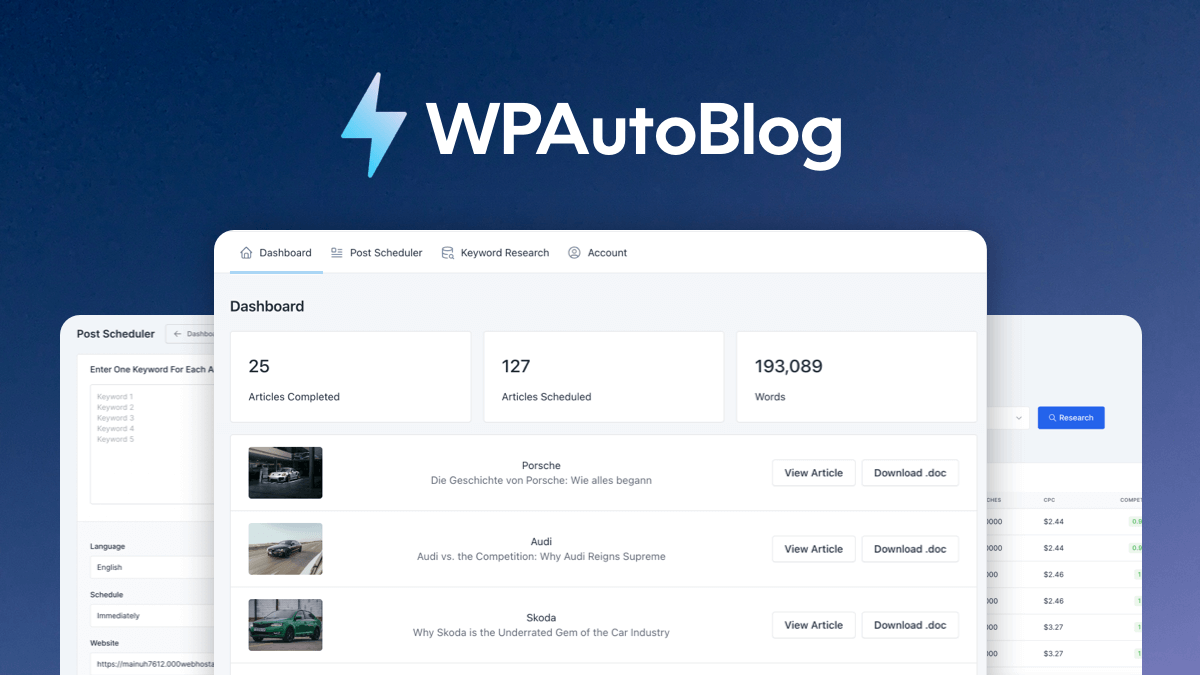
WPAutoBlog – AI Tool for Writing
AI-powered autoblogging for WordPress sites.
Reviews & Comments
Become the first to write about this tool
TL;DR — WPAutoBlog
AI-powered autoblogging for WordPress sites. Pricing starts from ₹1,586/mo with a free tier available. Security: Published posture.
What is WPAutoBlog?
WPAutoBlog is an autoblogging tool that combines an AI article writer with a smart scheduling system and keyword research to automatically post content on your Wordpress blog. The AI content generation is powered by ChatGPT. What sets WPAutoBlog apart from other AI content tools is the variety of settings available to create unique AI articles. Users have the ability to customize the writing style, ensuring that the generated articles closely resemble human-made content. Additionally, the tool incorporates SEO optimization by including proper H1/H2 title tags and NLP keyword optimization. WPAutoBlog allows users to connect multiple Wordpress sites simultaneously, with no limit to the number of blogs that can be connected. The platform is compatible with all versions of Wordpress, as long as the REST-API is enabled, which is enabled by default.Autoblogging, the core functionality of WPAutoBlog, refers to the automatic posting of content using a tool or software. With WPAutoBlog, users can automate the process of generating and publishing articles, saving time and effort.Overall, WPAutoBlog offers a comprehensive solution for those looking to automate their article writing and content posting on Wordpress. With its AI-powered content generation, customizable writing styles, SEO optimization, and compatibility with multiple Wordpress sites, WPAutoBlog helps users generate high-quality, SEO-friendly content effortlessly.
Security Assessment
Published posture scored 12/20 or above. We check HTTPS, a reachable privacy policy, and stated compliance commitments. We do not perform security testing.
Last assessed: 22 August 2026
How this score was built
Each scored criterion links to the published page it was derived from. Unscored criteria are marked, not guessed. This listing has not been hands-on tested.
- 8/10
Security & Data Privacy
The privacy policy outlines data collection and usage practices, and the site uses HTTPS.
Source: wpautoblog.com - 8/10
Functionality & Features
The homepage details various features of the product, including AI article generation and SEO capabilities.
Source: wpautoblog.com - Not assessed
Ease of Use
Requires hands-on use of the product.
- Not assessed
Pricing & Value
No citable published evidence in this pass.
- Not assessed
Reliability & Performance
Requires hands-on use of the product.
- 6/10
Integration Capabilities
The homepage mentions WordPress integration for automatic posting.
Source: wpautoblog.com - Not assessed
Customer Support
No citable published evidence in this pass.
- Not assessed
Company Stability
No citable published evidence in this pass.
- Not assessed
Update Frequency
No citable published evidence in this pass.
- 5/10
Startup-Friendliness
The homepage offers a free trial, indicating some level of startup-friendliness.
Source: wpautoblog.com
Frequently Asked Questions
What is WPAutoBlog and what does it do?
AI-powered autoblogging for WordPress sites.
What does WPAutoBlog cost in India?
WPAutoBlog starts at ₹1,586/month (plus 18% GST). A free tier is available to get started.
Is WPAutoBlog safe for startups?
WPAutoBlog has a published security posture scoring 12/20 or above (HTTPS, a reachable privacy policy, and/or stated compliance commitments). We do not perform security testing.
How is WPAutoBlog rated on One9Founders?
WPAutoBlog has not yet been rated on our 10-point evaluation framework. See How We Rate for the 10-criterion framework and status definitions.
Alternatives to WPAutoBlog

Claude is an AI chat assistant.

AI writing assistance tool for various applications.

Google’s multimodal AI assistant designed for creative and productive collaboration.

AI writing assistant for content generation.

HubSpot offers marketing, sales, and CRM software.

Where technical teams document.

AI content generation tool that enhances performance.
Unlimited Free AI Poem Generator